Supersonic Flight Without the Boom - Episode 70
Rick Crandall:
Welcome back to the Behind the Wings podcast, produced by Wings Over the Rockies Air and Space Museum in Denver, CO. We’ve got a lot to explore. Hi, friends. I’m your host, Rick Crandall. In this episode, we’re getting an inside look at NASA’s Quesst mission.
Our guests are Low Boom Flight Demonstrator Project Manager Cathy Bahm and Commercial Supersonic Technology Project Manager Lori Ozoroski. Imagine how big those name tags are.
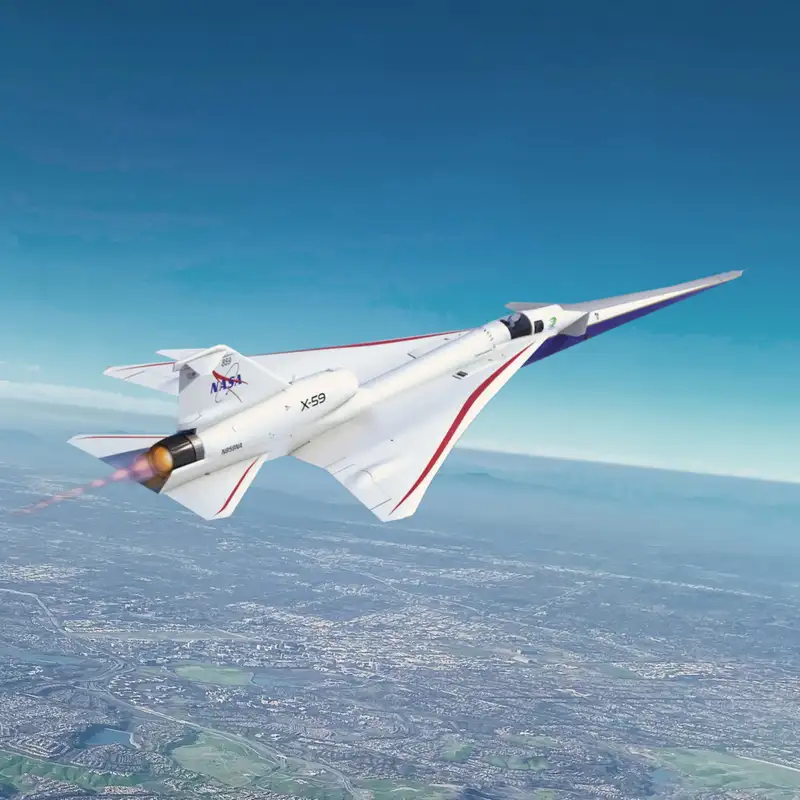
For decades, supersonic flight over land has been banned because sonic booms are too disruptive. NASA’s Quesst mission is working to change that by proving an aircraft that replaces the boom with a quiet sonic thump. At the center is the X-59, an experimental plane designed to gather real-world data, helping regulators rethink the rules and potentially bring faster overland supersonic travel back into reach.
This one is going to be cool. It’s time to go Behind the Wings.
All right, let’s get started then. Cathy Bahm, Lori Ozoroski, welcome to the show. It’s great having you here.
Cathy Bahm:
Thanks for having us.
Lori Ozoroski:
Yeah, it’s great to be here.
Rick Crandall:
All right, let’s get started with this. When most people hear NASA, they think of space. So what do you wish they understood about the aeronautics part of NASA? And why is the Quesst mission a perfect example of aeronautics at NASA?
Lori Ozoroski:
So I think it’s important to know that from the first days of NASA, aeronautics has been part of the mission. We’re contributing to that goal of expanding aeronautics and the future of aeronautics.
The Quesst mission is really special because we are looking to provide the data to change the regulations for commercial supersonic flight. That impacts everybody’s life, right? To be able for future generations to fly supersonic over land and get to their destinations in half the time.
Trying to change that regulation and open up that market is truly a NASA role for this program. It’s also important to note that what we’re attempting to do is something an individual company really wouldn’t be willing to take on and do for themselves. It’s risk reduction for the entire aerospace community. That’s really what NASA should be doing.
Rick Crandall:
Yeah, excellent. I want to get to know both of you a little bit more. What first pulled you into this world of supersonics, and tell us a little bit about your role on Quesst.
Lori Ozoroski:
I came to NASA just about 35 years ago, and I have been working supersonic transport technologies since I got here, really in a role of trying to understand: is it feasible? What sort of technologies need to be developed to make it feasible?
This mission was something that we came up with about a decade and a half ago, where we thought this was really something that we could do and gather the data we’re hoping to collect on reduced overland flight noise. For me, it’s a culmination of a long career in supersonics at NASA.
Rick Crandall:
So, Cathy—aircraft build and test ownership, kind of your role, right, if I simplified that down?
Cathy Bahm:
Yeah, that’s exactly it. I started at NASA as an intern and got the opportunity to do sonic boom testing and recording sonic booms of SR-71s and F-18s out at NASA Armstrong Flight Research Center. That was amazing.
When I came back, I ended up in the flight controls area and moved into other projects and opportunities that were more build-test kinds of activities—X-33, X-38, and then Hyper-X, which was X-43. We still have the world record for the fastest air-breathing aircraft.
Then into other activities and eventually ended up taking on this role, which is kind of like circling back to what I loved as an intern. The dream job of managing the build and test of an X-plane—if you had told my intern self that I’d get to do this, I wouldn’t have believed you. It’s decades in the making.
Rick Crandall:
Has it felt like decades?
Cathy Bahm:
Both. It feels like we signed the contract in 2018 just yesterday. And then some days it feels like it dragged to get here. Some weeks are harder than others. But when you have a week like first flight, it all seems like it happened quickly.
Lori Ozoroski:
My team is the research team that’s going to put the aircraft to use. The ideas of it came out of our group, and Cathy’s team has been building the aircraft while we’ve been patiently—and sometimes impatiently—waiting for it so we can do our research.
Rick Crandall:
All right, let’s go back in time. Concorde first flew in 1969 and proved supersonic commercial flight was possible. What did it also prove about what wouldn’t work long term?
Lori Ozoroski:
The fact that it created these loud sonic booms when flying over land. Regulations were put in place to not allow that to happen because the sonic boom is a very disruptive sound to people on the ground. It really limited the places they could fly that aircraft around the world.
Cathy Bahm:
Even now, in our community out at Edwards, when we have sonic booms in the area, there are pop-ups from neighborhoods asking, “Was that an explosion?” You could imagine if that was happening regularly over your house how disturbing that would be.
Rick Crandall:
Lori, explain how a sonic boom forms and what’s happening around the airplane when it breaks the sound barrier.
Lori Ozoroski:
When you’re flying subsonic, the air around the aircraft can inform the air in front of it to get out of the way. When you’re flying supersonic, you don’t have that ability. All of that air pressure piles up. Various parts of the aircraft reach supersonic speeds at different times, and those pressure waves travel all the way to the ground and create the sonic boom.
The goal of this airplane is to spread out those pressure waves so they don’t all pile up into one really strong pressure wave.
Rick Crandall:
OK. So, Cathy, the first time I looked at the X-59, far from an everyday aircraft. What makes it look so different, and what about the plane makes it quiet?
Cathy Bahm:
It does not look like every other plane, and it’s all designed around exactly what Lori described about the placement and strength of shock waves.
The nose is one of the key features. It’s almost a 100-foot-long aircraft, and about a third of it is the nose. It’s that way so there’s a very gradual change in the area of the nose, so the shock waves coming off are not strong.
The engine is above the wing, and that’s key. If it were below, like on an F-16, the engine shock wave is substantial and goes down. On X-59, the wing helps capture most of what would go downward.
We tried to keep everything we could off the bottom of the aircraft to control the shock waves coming down to the ground.
We reused parts from other aircraft—F-16 landing gear, T-38 canopy and ejection seat, and a GE engine from an F/A-18E/F. The T-tail helps tune the shock waves coming off the back end of the aircraft.
The way it looks is all to achieve quiet supersonic flight.
Rick Crandall:
The X-59 doesn’t have a normal forward window.
Cathy Bahm:
That’s right. We have an External Vision System—a camera on the nose feeding a high-definition display in the cockpit—and a Forward Vision System for landing. That technology was developed by NASA Langley.
Rick Crandall:
We used to design airplanes and hope we liked the sound. Now the sound and the design evolve together. What changed?
Lori Ozoroski:
The idea of shaping a sonic boom has been around for decades, but computational fluid dynamics tools have gotten much better and much faster. Designing for low boom requires understanding what’s happening not just on the aircraft but around it in three dimensions.
The propagation tools that take pressure waves from altitude down through the atmosphere have also improved dramatically. For this aircraft, our predictions match wind tunnel data very well, so we have a lot of confidence—but we still have to see what the actual aircraft does.
Rick Crandall:
Take me to October 28th, first flight.
Cathy Bahm:
We took off from Palmdale at Lockheed Skunk Works, flew to Edwards, and landed at NASA Armstrong. Leading up to that, we had engine runs, afterburner testing, electromagnetic interference testing, integrated testing, taxi tests, and high-speed taxi. Each step validated that we were ready.
Rick Crandall:
When did you exhale?
Cathy Bahm:
When it turned off the runway into the taxiway.
Rick Crandall:
From the mission perspective, first flight is the start. What data do you still need before community work?
Cathy Bahm:
We need to clear the rest of the flight envelope—make sure all altitudes and speeds are safe and perform as expected.
Lori Ozoroski:
Then we validate the acoustics. We’ll use an F-15 with a shock sensing probe to measure the shock structure around the aircraft, ground recording arrays to measure what reaches the surface, and extensive meteorological measurements. Temperature, turbulence, and humidity all affect what people hear on the ground.
We need to validate our tools before Phase 3, which is community response testing. We need to know what we’re exposing people to and be able to predict it accurately.
Rick Crandall:
If Quesst works, what changes first?
Lori Ozoroski:
We provide the data to the FAA and international regulatory bodies. They establish certification requirements for overland supersonic flight. Companies won’t cut metal until they understand those requirements.
Rick Crandall:
Cathy, when the X-59 produces a thump instead of a boom, what will that mean to you?
Cathy Bahm:
It will be a career highlight. To build and fly a quiet supersonic aircraft and provide the data that could inform regulatory change—that’s extraordinary.
Rick Crandall:
Ladies, thank you both for your time. We’ll be watching closely.
Thank you, Cathy Bahm and Lori Ozoroski, for joining us. This is the kind of mission that could fundamentally change how we travel in the future.
That’s going to do it, folks. We hope you enjoyed Episode 70 of the Behind the Wings podcast. Visit wingsmuseum.org/podcast to access the show notes. Make sure to subscribe wherever you listen and leave a review. It’s the best way to help new people discover the show.
We’ll see you next time, right here on Behind the Wings.